Mechanical Engineering · Santa Clara University · Class of 2029
Julian Trotzenberg
Wind tunnels, 3D printed parts, machined aluminum. Aiming at aerospace, product design, and electric vehicles.
Mechanical Engineering · Santa Clara University · Class of 2029
Wind tunnels, 3D printed parts, machined aluminum. Aiming at aerospace, product design, and electric vehicles.
Seven projects, from a homemade wind tunnel to a first machined part.
Aerodynamics Research
Seven 3D printed airfoils, three wind speeds, and over a thousand data points to find the wing sweep angle that maximizes lift to drag. The same variable sweep logic that shaped the F-14 Tomcat.


Designed in Fusion 360. Seven NACA 0015 airfoils spanning 0° to 60° of sweep, printed to 0.2 mm accuracy on a Bambu X1 Carbon.
Engineered for clean data. Two tunnel iterations with a laminar flow straw inlet, pulley based drag measurement, and a rail mounted force isolation cart.
A real result. Drag falls off sharply past 30° of sweep while lift follows a cos squared relationship, supporting variable sweep aircraft design.
Product Design
A school IT department was losing eight peripherals a year at about €120 each. One interview, six concepts, and four prototype iterations later: a tested retention device that costs €0.86 to print.


Started with an interview. Conversations with the IT director produced a 16 point design specification covering child safety, ergonomics, and material toxicity.
Chosen by scoring. Six competing concepts modeled in Fusion 360, narrowed through a weighted decision matrix and client feedback.
Proven by testing. The final PLA print passed a 10 N magnetic pull test and survived 20 drops from 1.5 m, with no sharp edges or choking hazards.
Composites and Flight
An FPV drone built together with a friend, flying on a chassis we laid up ourselves in carbon fiber. From raw cloth and resin to a stiff, lightweight frame with the full flight stack mounted on top.


Laid up by hand. Woven carbon fiber wrapped and cured over a printed core, giving a one piece frame instead of flat cut plates.
Built in two halves. Constructed as two shells with curvature designed for maximum roll rigidity to weight ratio.
A full flight stack. Flight controller and ESC stack, FPV camera, and four brushless motors wired directly onto the frame.
Avionics and Systems
An Eclipson Model G1 Wolf, 3D printed on a Bambu X1 Carbon and fitted with a full avionics stack: brushless motor, ESC, servos, FlySky receiver, and LiPo power. An ongoing build, currently waiting for me back in Germany.


CNC Machining
As Co-STEAM Chair of Alpha Kappa Psi, I organized a company visit to AMD. To mark the event, I designed and CNC machined a custom aluminum piece engraved AMD × AKΨ.


First chips. CAM setup, workholding, and toolpaths for a first machined part, cut in 6061 aluminum.
Engraved to mark the event. Custom AMD × AKΨ engraving designed to commemorate the visit, hosted by Jerry Wong of AMD.
Beyond the shop. Coordinated the visit end to end with Co-STEAM Chair Justin Shao, from outreach to the on-site program.
Propulsion
A multi-part scale model of the SpaceX Raptor engine, printed in black and white PLA with turbopumps, plumbing, and bell geometry. Driven by an interest in full flow staged combustion.


Interactive 3D scan coming soon.
Multi-material print. Black and white PLA passes capturing the turbomachinery, plumbing runs, and nozzle bell.
Printed to learn. The easiest way to figure out how a rocket engine actually works is to put one on your desk.
Scanned in 3D. A Gaussian splat capture is in the works, so you can soon orbit the real object right on this page.
Chemistry
A potassium nitrate and sugar caramel propellant, mixed, cast, and ignited in the backyard. A first experiment in oxidizer to fuel ratios and burn behavior.


KNO₃ and sugar. Caramelized propellant compound mixed to a controlled oxidizer to fuel ratio.
No questions asked. Thankfully none of my neighbors questioned the massive plume of smoke in the sky.
Ignition tested. Burn rate and plume behavior observed across test firings.
I'm a mechanical engineering student at Santa Clara University. Most of what I've learned came from projects: a wind tunnel in my bedroom, a torn down 100cc engine, a half printed RC plane waiting for me back in Germany.
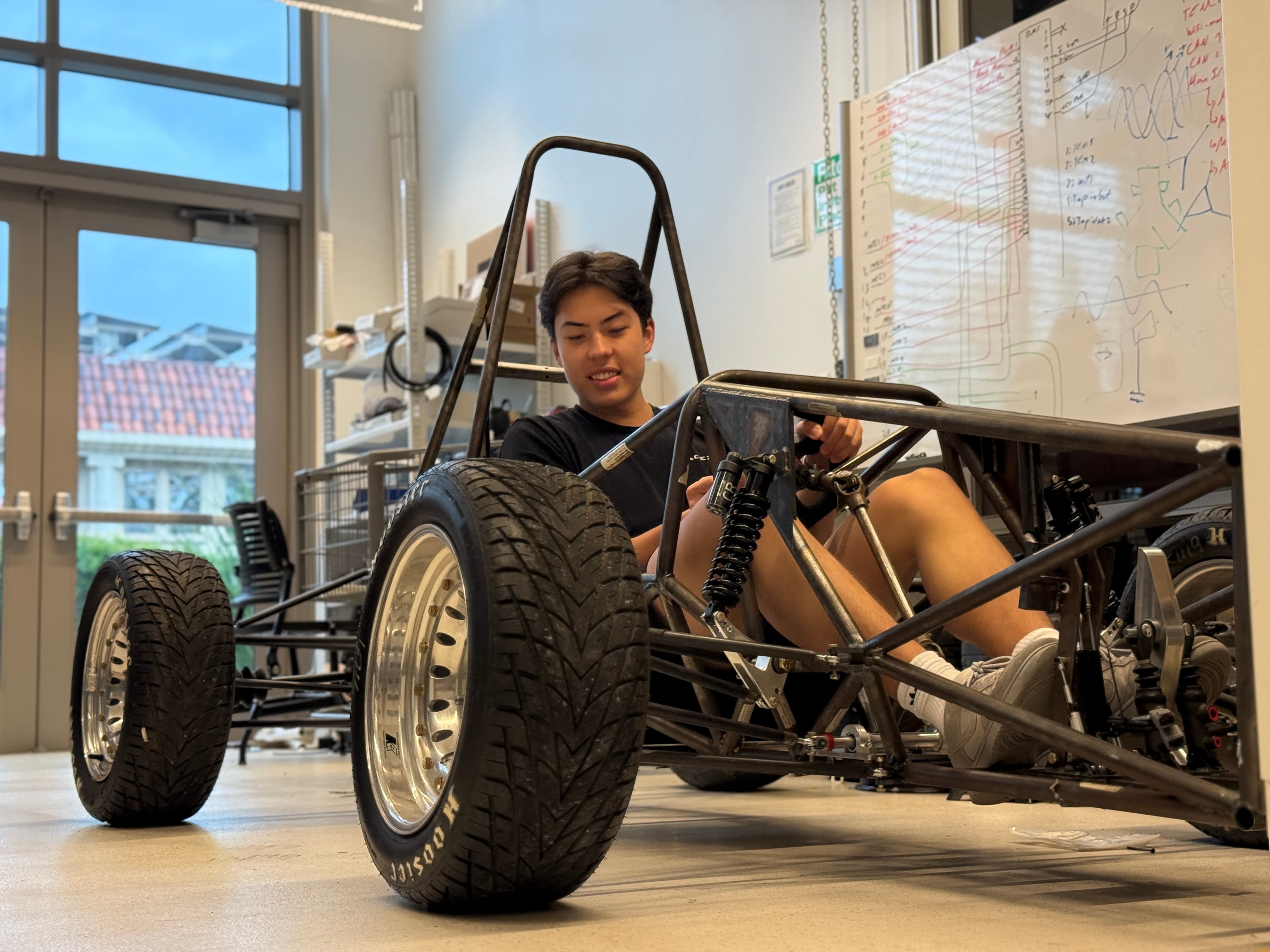
These days most of my time goes to the SCU Formula SAE team, where I design and simulate suspension components. I'm looking for summer 2027 internships in aerospace, EVs, product design, or defense.